
SIGN UP for Trade Ideas, Tools, & Training ↑
THE OPTIONSGEEK FRAMEWORK
Options vs. Stock: When Should You Use Options?
Capital-efficiency ratios are commonly used to decide whether to use options instead of stock. But they fail as a decision framework by assuming the investor has already chosen the right option. That exposes a bigger problem: the options industry never clearly answers the directional investor’s most basic question, “Which option should I buy and why?”
This page shows how the OptionsGeek framework developed by Felix Frey solves that problem first, then determines how much option exposure to use.
What is Capital Efficiency?
Capital efficiency compares the amount of capital required to create a desired level of exposure or potential return.
For example, an option can require a fraction of the capital needed to own the underlying stock while still providing meaningful participation if the stock reaches the investor’s target price.
That is one of the major benefits of options.
But using less capital does not automatically make the option a better trade.
Why Capital-Efficiency Ratios Aren’t Enough
Investors commonly compare stock and options using measures such as cash outlay, leverage, and return on capital.
CAPITAL-EFFICIENCY METRIC
WHAT IT MEASURES
WHAT IT MISSES
Cash-Outlay Ratio
Capital required by the option relative to the stock
Whether the option is attractive at its current price
Delta-Adjusted Leverage
Current stock exposure generated per dollar of option premium
Whether the strike fits the investor’s target, time frame, and confidence
Return on Capital
Projected profit relative to the capital committed
Whether the option offers attractive risk-reward at its current price
CAPITAL-EFFICIENCY METRIC
Cash-Outlay Ratio
WHAT IT MEASURES
Capital required by the option relative to the stock
WHAT IT MISSES
Whether the option is attractive at its current price
CAPITAL-EFFICIENCY METRIC
Delta-Adjusted Leverage
WHAT IT MEASURES
Current stock exposure generated per dollar of option premium
WHAT IT MISSES
Whether the strike fits the investor’s target, time frame, and confidence
CAPITAL-EFFICIENCY METRIC
Return on Capital
WHAT IT MEASURES
Projected profit relative to the capital committed
WHAT IT MISSES
Whether the option offers attractive risk-reward at its current price
These measures can compare capital, exposure, and projected return, but they all assume the investor has already chosen the right option.
That is the problem. You cannot compare an option with the stock until you first know which option you want to use.
But this leads to an even bigger problem: How do you choose the right option in the first place?
Contrary to traditional options education, the starting point is not the option chain, the Greeks, or implied volatility. It's the investor’s view of the stock.
Find the Attractive Option First
For a directional investor, the stock view has three components:
TARGET PRICE
Where do you think the stock can go?
TIME FRAME
When do you expect it to get there?
CONFIDENCE
How confident are you in that outcome?
Those three inputs define the investor’s view of the stock. The next step is to compare that view against the market expectations embedded in the available options.
That comparison reveals whether the stock idea actually creates an attractive options opportunity and, if it does, which strike offers the most attractive risk-reward.
OptionsGeek measures that difference using Edge.
Edge is the percentage advantage an option offers based on the investor’s expectations relative to what the market has priced into that option.
YOUR VIEW
Target Price
Time Frame
Confidence
vs.
MARKET PRICING
What the option market has already priced in
→ EDGE
Your risk-reward advantage
YOUR VIEW
Target Price
Time Frame
Confidence
vs.
MARKET PRICING
What the option market
has already priced in
→ EDGE
Your risk-reward advantage
The goal is not to find the lowest-priced option or the option with the highest potential percentage return. The goal is to determine whether an attractive options opportunity exists and, if it does, identify the option that best fits the investor’s view.
That is the process the OptionsGeek Strike Selector guides investors through, powered by the patented New Options Chain.
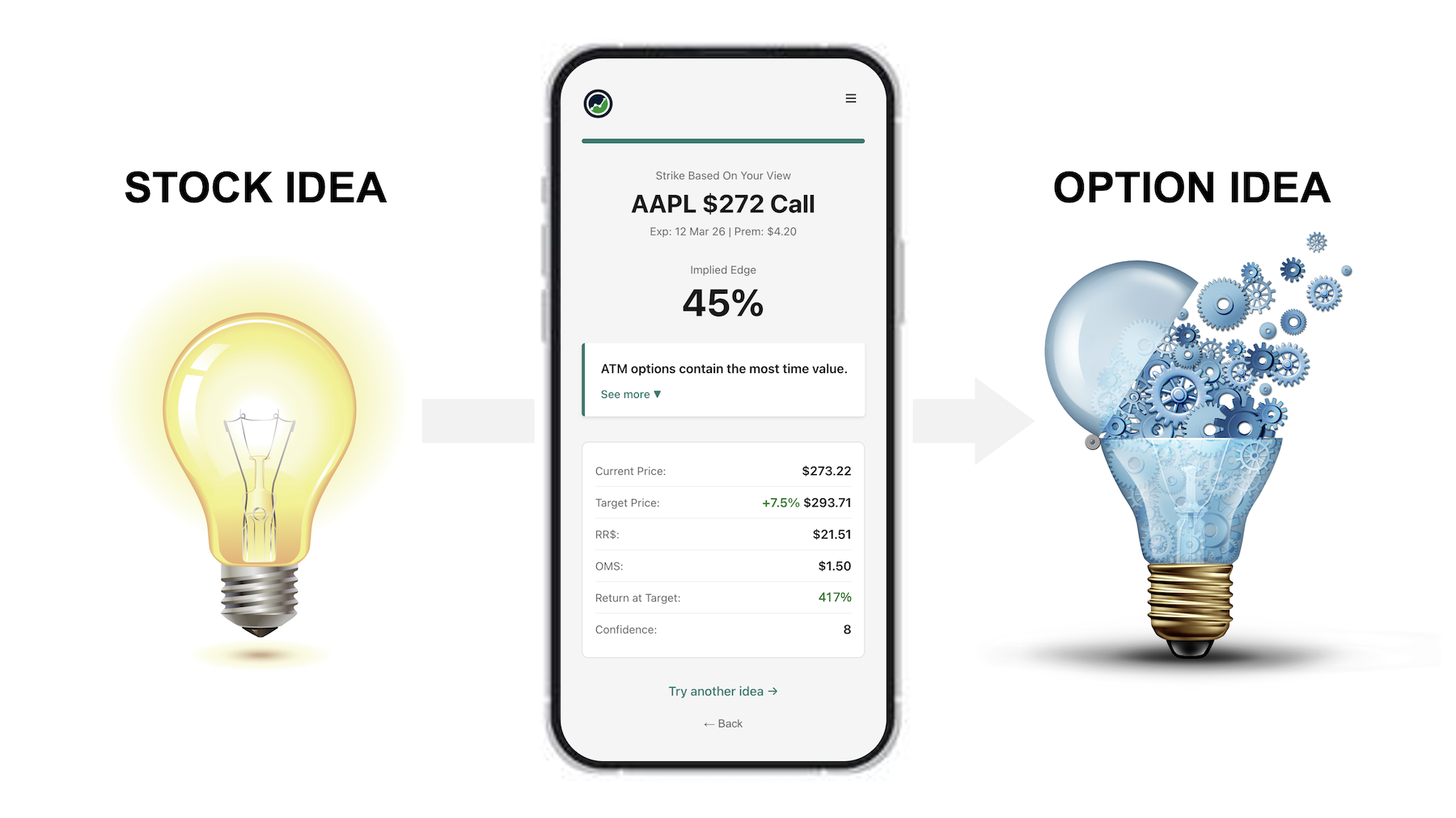
THE OPTIONSGEEK STRIKE SELECTOR
How to Move from Stock to Options
Once you have identified an option with attractive Edge, the next step is to determine how much option exposure corresponds to the stock position you are considering replacing.
There are two practical ways to do that.
METHOD 1
Compare Potential Profit
Question: How many option contracts would give me similar upside to the stock position?
Start with the stock position you would normally own and calculate the potential dollar profit if the stock reaches your target price.
Then calculate the potential dollar profit of one option contract at that same target.
Formula:
Stock Profit
at Target
÷
Option Profit per Contract at Target
Stock Profit at Target
÷
Option Profit per Contract at Target
Stock Profit at Target
÷
Option Profit per
Contract at Target
= Approximate # of Option Contracts
= Approximate # of
Option Contracts
Example:
If 100 shares of stock would produce a $2,000 profit at your target, and one option contract would produce a $700 profit:
$2,000 ÷ $700 = 2.86 contracts
So approximately three option contracts would provide similar upside to the 100-share stock position at your target price.
Profit Method → Matches Upside
METHOD 2
Compare Potential Loss
Question: How many option contracts can I own while keeping my downside risk similar to the stock position?
Start with the amount you are willing to lose on the stock position. Then compare that with the amount of premium at risk in one option contract.
Formula:
Acceptable Stock Loss
÷
Option Premium at Risk per Contract
Acceptable Stock Loss
÷
Option Premium at Risk
per Contract
= Approximate # of Option Contracts
= Approximate # of
Option Contracts
Example:
If you are willing to lose $600 on the stock position, and one option contract puts $300 of premium at risk:
$600 ÷ $300 = 2 contracts
So two option contracts would keep the maximum premium at risk comparable to the loss you were willing to accept on the stock.
Example:
If you are willing to lose $600 on the stock position, and one option contract puts $300 of premium at risk:
$600 ÷ $300 = 2 contracts
So two option contracts would keep the maximum premium at risk comparable to the loss you were willing to accept on the stock.
Loss Method → Matches Downside
These two methods answer different questions:
1. Profit comparison matches upside.
2. Loss comparison matches downside.
Edge determines whether the option is attractive enough to use. These methods help determine how much option exposure to own.
Options Don’t Have to Replace the Stock
Knowing how many option contracts correspond to a stock position does not mean the entire position has to be replaced.
Options offer leverage and asymmetric upside, but they also carry the risk of losing the premium. For many investors, that makes a combination of stock and options more practical than choosing one or the other.
Once an option offers attractive Edge, the decision does not have to be all stock or all options.
STOCK ONLY
Keep the exposure entirely in shares.
STOCK + OPTIONS
Keep stock as the core position and use options to add leverage and asymmetric upside.
The stock can remain the core position, while a portion of the exposure is shifted into options when the options offer attractive Edge.
For example, if the analysis shows that three option contracts provide similar upside to 100 shares, an investor does not necessarily have to choose between:
100 shares
or
3 option contracts
The investor could instead keep part of the stock position and use options for the remaining exposure.
The goal is to use options where they improve the risk-reward of the overall opportunity without taking more premium risk than the investor is comfortable accepting.
FOR SMALLER ACCOUNTS
Why Options Can Matter More for Smaller Accounts
100 SHARES OF A $200 STOCK
$20,000 in capital
OPTIONS EXPOSURE
Less capital required
For investors with smaller accounts, options can solve a different problem: access.
Buying enough shares of a higher-priced stock to create meaningful upside may require too much capital or create too much concentration in a single position.
When the stock idea also creates an attractive options opportunity, options can allow the investor to gain exposure with less capital.
But the same rule still applies:
Using less capital does not automatically make the option a good trade.
The option still needs to offer attractive risk-reward relative to the investor’s target price, expected time frame, and confidence.
Capital efficiency is a benefit of options. It is not, by itself, a reason to buy them.
The OptionsGeek Decision Process
STOCK IDEA → OPTIONS OPPORTUNITY? → EVALUATE EDGE → CHOOSE THE OPTION →
DECIDE THE STOCK + OPTIONS MIX → SIZE THE POSITION
STOCK IDEA
↓
OPTIONS OPPORTUNITY?
↓
EVALUATE EDGE
↓
CHOOSE THE OPTION
↓
DECIDE THE STOCK + OPTIONS MIX
↓
SIZE THE POSITION
Capital efficiency should help size the position, not determine whether the option is worth buying.

Information contained in any email and this website maintained by OptionsGeek, LLC (“OptionsGeek”) are provided for educational purposes only and are neither an offer nor a recommendation to buy or sell any security, options on equities or indices, or cryptocurrency. OptionsGeek and its affiliates may hold a position in any of the companies mentioned. OptionsGeek is neither a registered investment adviser nor a broker-dealer and does not provide customized or personalized recommendations. Any one-on-one coaching or similar products or services offered by or through OptionsGeek does not provide or constitute personal advice, does not take into consideration and is not based on the unique or specific needs, objectives or financial circumstances of any person, and is intended for educational purposes only. Past performance is not necessarily indicative of future results. No trading strategy is risk free. Trading and investing involve substantial risk, and you may lose the entire amount of your principal investment or more. You should trade or invest only “risk capital” - money you can afford to lose. Trading and investing is not appropriate for everyone. We urge you to conduct your own research and due diligence and obtain professional advice from your personal financial adviser or investment broker before making any investment decision.
OptionsGeek, LLC @2026 All Rights Reserved