
THE OPTIONSGEEK FRAMEWORK
What Is Risk-Reward Breakeven Price (RR$)?
Risk-Reward Breakeven Price (RR$) is an OptionsGeek concept developed by Felix Frey that expresses the risk-reward of a specific option as a stock-price line at expiration. Because every option has its own RR$, investors can compare different strikes against one Target Stock Price instead of judging options by premium alone. In simple terms, RR$ helps investors determine which options look cheap or expensive relative to their expectations.
What Is RR$?
Risk-Reward Breakeven Price (RR$) is the stock price at expiration where the risk and reward embedded in the market price of a specific option are balanced.
I developed RR$ because option premiums are difficult to compare.
At face value, a $0.50 option may look cheap and a $3 option may look expensive. However, the premium alone does not tell you which option actually offers the more attractive risk-reward.
That creates a major problem for investors: they can easily mistake a low-priced option for a good value, choose the wrong strike, and take far more risk than they realize.
RR$ solves this by translating the risk-reward embedded in the market price of the option into a stock-price scale. That allows the investor to compare it against something they already understand: the Target Stock Price established from their stock research.
Ultimately, this comparison helps answer one of the most important questions when choosing an option:
Is this option cheap or expensive relative to what I believe the stock can achieve?
RR$ Normalizes the Options Chain
The options chain can be intimidating for many investors. Over the years, the industry has added more and more information for each strike, including the Greeks and implied volatility.
Investors are left with a sea of data but still struggle to answer a simple question:
STANDARD OPTIONS CHAIN
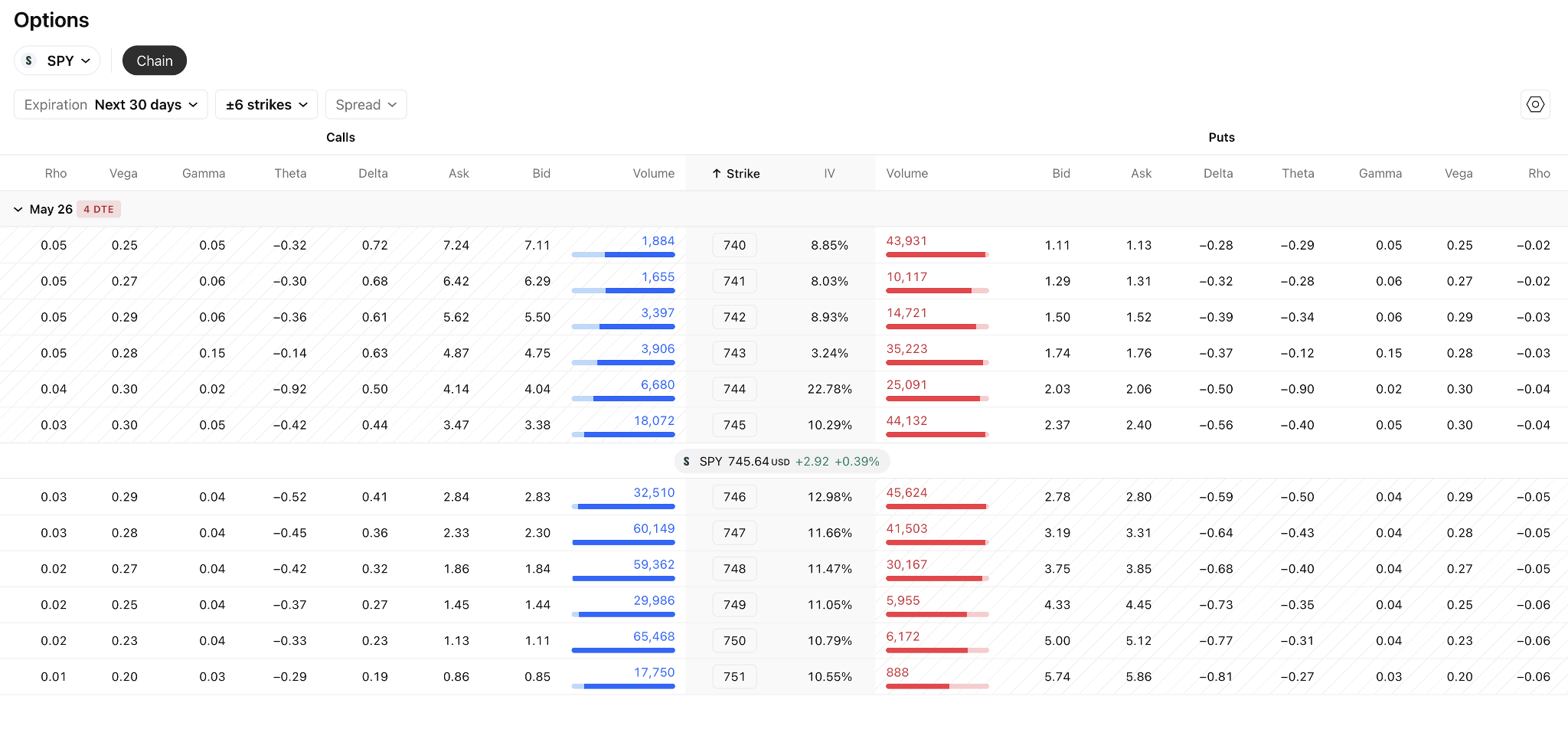
Which option do I buy and why?
To answer that, investors need a way to compare different options and determine which ones offer the best value, if any, given their stock view.
RR$ starts that comparison.
Every option has its own RR$ because each option has a different strike, premium, expiration, and payoff profile.
By translating each option into an RR$, investors can compare their choices on the same scale and begin eliminating the expensive ones, quickly narrowing the field.
For example, three call options on the same stock might have:
Option A: RR$ = $125
Option B: RR$ = $138
Option C: RR$ = $155
These three RR$s do not mean the market expects the stock to finish at three different prices. Each one reflects the risk-reward embedded in the market price of that specific option.
Now suppose your research produces a Target Stock Price of $150.
Option A has an RR$ of $125, so it looks cheap relative to your target.
Option B has an RR$ of $138, so it also looks cheap, although the cushion is smaller.
Option C has an RR$ of $155. Because its RR$ is above your $150 target, it looks expensive and should not be considered.
Target Stock Price: $150
Option A — RR$ $125
Option B — RR$ $138
Option C — RR$ $155
Cheap
Cheap
Expensive
Target Stock Price: $150
Option A — RR$ $125 — Cheap
Option B — RR$ $138 — Cheap
Option C — RR$ $155 — Expensive
This is what it means to normalize the options chain: every option can now be compared against one common benchmark, the investor’s Target Stock Price.
FAQs About Risk-Reward Breakeven Price (RR$)
Is RR$ a stock-price forecast?
No. RR$ does not predict where a stock will trade. It represents the stock price at expiration where the risk and reward embedded in the market price of a specific option are balanced. The investor’s Target Stock Price is their expectation for the stock.
Why does every option have a different RR$?
Each option has a different strike, premium, expiration, and payoff profile. As a result, each option has its own RR$.
Does a cheaper option premium mean better value?
No. A lower-priced option may simply require a larger stock move or carry a greater probability of losing the premium. RR$ allows investors to evaluate value relative to their Target Stock Price rather than judging an option by premium alone.
How is RR$ different from Target Stock Price?
Target Stock Price comes from the investor’s research and represents where they believe the stock can go. RR$ comes from the market price and payoff of a specific option. Comparing the two helps determine whether that option appears cheap or expensive relative to the investor’s view.
Does RR$ tell me which option to buy?
Not by itself. RR$ gets the comparison process started by helping investors eliminate options that appear expensive relative to their Target Stock Price. Other factors are needed to determine which of the remaining options offers the most attractive opportunity.
Where RR$ Is Used Inside OptionsGeek
RR$ is built into the Strike Selector and the New Options Chain, where it helps investors compare different options against their Target Stock Price.
It is one of the core concepts OptionsGeek uses to evaluate whether an option appears cheap or expensive relative to the investor’s stock view.
The Next Question
RR$ helps identify which options look cheap or expensive relative to the investor’s Target Stock Price. But once the expensive options are eliminated, the next question is:
How cheap are the remaining options?
That requires measuring the dollar cushion between the Target Stock Price and each option’s RR$.
That measurement is the Options Margin of Safety (OMS).
Explore Related Concepts

Information contained in any email and this website maintained by OptionsGeek, LLC (“OptionsGeek”) are provided for educational purposes only and are neither an offer nor a recommendation to buy or sell any security, options on equities or indices, or cryptocurrency. OptionsGeek and its affiliates may hold a position in any of the companies mentioned. OptionsGeek is neither a registered investment adviser nor a broker-dealer and does not provide customized or personalized recommendations. Any one-on-one coaching or similar products or services offered by or through OptionsGeek does not provide or constitute personal advice, does not take into consideration and is not based on the unique or specific needs, objectives or financial circumstances of any person, and is intended for educational purposes only. Past performance is not necessarily indicative of future results. No trading strategy is risk free. Trading and investing involve substantial risk, and you may lose the entire amount of your principal investment or more. You should trade or invest only “risk capital” - money you can afford to lose. Trading and investing is not appropriate for everyone. We urge you to conduct your own research and due diligence and obtain professional advice from your personal financial adviser or investment broker before making any investment decision.
OptionsGeek, LLC @2026 All Rights Reserved