
SIGN UP for Trade Ideas, Tools, & Training ↑
The Wheel Strategy: The Risks Most Investors Are Never Taught
The Wheel is a valid options strategy, but the risks go far beyond assignment. Here’s what investors need to understand about sizing, stock selection, gap risk, and institutional use.
The Wheel is one of the most popular options strategies taught to individual investors. Its appeal is easy to understand. An investor identifies a stock he would like to own, sells a cash-secured put, collects premium, and either repeats the process if the option expires worthless or accepts the shares if assigned. Once the shares are owned, covered calls are sold against the position until the stock is eventually called away.
Mechanically, there is nothing inherently wrong with the strategy. The Wheel is a valid options strategy, and under the right circumstances it can be used successfully. The problem is that the mechanics are usually much easier to explain than the risks.
That distinction matters because most of the serious risks in the Wheel do not come from misunderstanding how to sell a put or write a covered call. They come from decisions that happen before and after the option trade: how the stock was selected, how large the exposure is relative to the portfolio, what happens when the stock moves sharply, whether the investor's thesis changes, and how much flexibility was surrendered by selling the option in the first place.
I recently walked through these issues in a one-on-one coaching session with an OptionsGeek member who was considering the Wheel. Rather than starting with strike selection or premium collection,
I started with a more fundamental question:
What type of investment strategy is the Wheel actually asking you to follow?
That question exposes much of the confusion surrounding the strategy.
The Wheel Blurs Long-Term Investing and Short-Term Trading
Long-term investing and short-term trading are not simply two different holding periods. They generally involve different methods of analysis, different reasons for entering positions, and different ways of determining when an investment thesis has failed.
A long-term investor may own a company for years because of its competitive position, management, industry structure, cash-generation potential, or long-term growth prospects. Price matters, but the investment thesis is driven primarily by the expected development of the underlying business.
A short-term trader is solving a different problem. Fundamentals can still matter, but catalysts, technical levels, positioning, supply and demand, options activity, and shorter-term market expectations become much more important. A position may be attractive for several weeks even though the investor has no desire to own the company for five years.
The Wheel can blur those two disciplines in a way that deserves more attention.
An investor may begin by selling a put with only a few weeks until expiration. The objective is immediate: collect premium while waiting for the stock. Yet if the stock subsequently falls and the put is assigned, the explanation often changes. The investor is now reminded that he wanted to own the stock anyway, that he should be willing to hold it, that he can continue selling calls, and that he may even want to sell more puts at lower prices.
WHEEL LIFE CYCLE
Short-term Premium Seller →
Assignment →
Long-term Stockholder?
WHEEL LIFE CYCLE
Short-term Premium Seller
↓
Assignment
↓
Long-term Stockholder?
The strategy began as a short-term options trade. A sufficiently large loss can turn it into a long-term investment.
That transition is not necessarily wrong. It becomes dangerous when it occurs automatically rather than because the investor has deliberately reevaluated the company and concluded that long-term ownership remains attractive.
Long-Term Investors Still Need a Definition of “Wrong”
One of the common defenses of the Wheel is that assignment does not matter because the investor intends to own the stock for the long term. That argument only works if the investor actually has a long-term thesis.
Long-term investors do not necessarily use the same price stops as active traders, but that does not mean they have no stops at all. Their stop may be fundamental rather than technical.
Suppose an investor owns a company because a particular management team has successfully executed a multiyear turnaround. If the chief executive unexpectedly leaves, the original thesis may need to be reassessed. The same is true if the company loses a critical customer, discovers accounting irregularities, suffers a structural deterioration in its economics, or faces a competitive development that materially changes its future prospects.
A stock price decline by itself does not necessarily invalidate a long-term thesis. But neither does the label “long-term investor” make every decline irrelevant.
This distinction becomes especially important with the Wheel because assignment can encourage investors to redefine a losing trade as a long-term investment after the fact. The correct question is not whether the investor is willing to wait. It is whether the reason for owning the business remains intact.
If there was never a sufficiently developed thesis to answer that question, the investor was not truly prepared to become a long-term owner simply because a short put was assigned.
A High Win Rate Does Not Mean a Strategy Is Low Risk
Another source of the Wheel's appeal is the frequency with which option-selling trades can produce profits. Selling an out-of-the-money put may provide a relatively high probability of retaining the premium, and a long sequence of profitable trades can make the strategy feel unusually consistent.
Probability alone, however, does not define risk.
An option seller typically receives a relatively small premium in exchange for accepting a potentially much larger adverse outcome. The fact that the favorable outcome occurs more frequently does not eliminate the magnitude of the unfavorable one.
Consider a simplified example in which an option seller has a 70% probability of earning $1. Over a large number of observations, seven profitable outcomes do not imply that the remaining three outcomes are inconsequential. The market price must also reflect the potential magnitude of those losses.
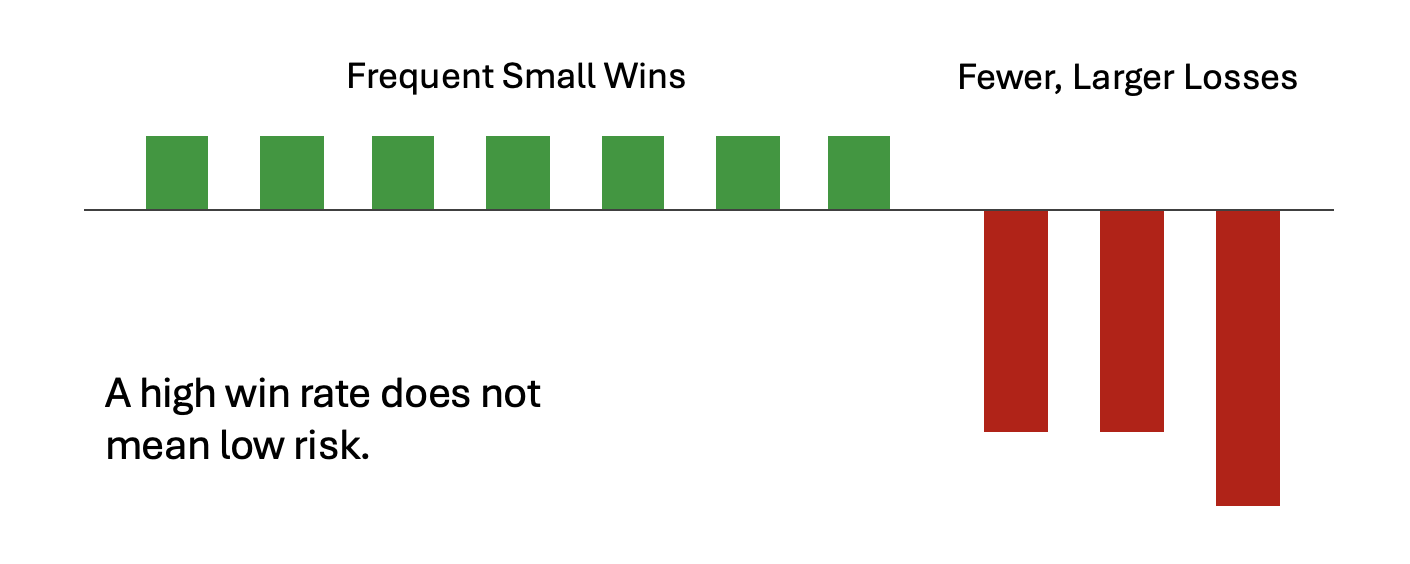
This is one of the fundamental differences between option buying and option selling. The option buyer can lose the entire premium, but that maximum premium loss is known at inception. The buyer accepts a lower probability of success in exchange for a payoff that can be substantially larger than the initial investment. The seller receives the opposite profile: frequent smaller gains accompanied by exposure to less frequent but potentially much larger losses.
Neither side is automatically superior. The important point is that win rate cannot be evaluated independently of payoff.
This is particularly relevant to the Wheel because months of collected premium can create the impression that the strategy has produced steady income with limited risk. One large decline in the underlying stock can overwhelm a significant amount of previously collected premium.
Institutional Put Selling Is Not the Same as the Retail Wheel
Investors sometimes ask whether professional institutions use the Wheel. The more useful answer is that institutional investors can use pieces of the same toolkit, but often in a very different context.
Imagine a large asset manager that has decided to build a substantial position in a company. If the desired position represents millions of shares, the institution cannot simply purchase all of them at once without considering liquidity and market impact. Accumulation may occur over days or weeks, with the investor becoming more aggressive at lower prices and less aggressive as the stock rises.
Selling puts can be incorporated into that accumulation process. If the institution is already prepared to acquire additional shares at a lower price, it may sell puts representing a fraction of the desired stock position. Later, after accumulating the shares and seeing the stock appreciate, it might sell calls against another fraction of the holding.
From the outside, those trades can resemble the components of the Wheel. Economically, however, the context can be very different.
A put position representing two million shares sounds enormous in isolation. If the institution is trying to build a 25-million-share position, the option exposure represents only a small percentage of the intended investment. Likewise, selling calls against one or two million shares does not mean the institution is attempting to exit the entire stock position.
Retail Wheel vs. Institutional Put Selling
RETAIL WHEEL
INSTITUTIONAL USE OF PUTS
Portfolio: $10,000
Intended stock position: 25 million shares
Sell 1 put on a $50 stock
Sell puts representing ~2 million shares
Notional exposure: $5,000
Put exposure: ~8% of intended position
50% of the portfolio tied to one contract
Puts are only one small part of a much larger accumulation plan
→ The same option strategy can represent completely different portfolio risk depending on size.
This is why simply observing that institutions sell puts or covered calls tells an individual investor very little about whether the same strategy is appropriate for his portfolio.
The relevant questions are how large the option position is relative to the total investment, what the institution is trying to accomplish, what research supports the underlying stock thesis, and what other exposures exist around the trade.
The option is only one piece of a much larger portfolio decision.
Cash-Secured Does Not Mean Low Risk
The distinction between cash-secured puts and puts sold on margin is important. Excessive margin can magnify losses, create forced liquidation risk, and allow an investor to accumulate exposure far beyond what the portfolio could otherwise support.
Using cash instead of margin removes some of those dangers. It does not make the underlying trade safe.
Suppose a stock trades at $85 and an investor sells an $85 put for $4. If assigned, the effective stock cost is approximately $81. That may look attractive compared with simply buying the stock at $85.
Now suppose the stock falls to $60.
The investor effectively owns something worth $60 for approximately $81. The $4 premium reduced the loss, but it did not eliminate the stock risk. Whether the original put was fully cash secured has no bearing on the economic deterioration of the position.
“Cash-secured” describes how the obligation is funded. It should not be confused with a description of the investment's risk.
That distinction becomes particularly important in smaller accounts, where one option contract can represent a surprisingly large percentage of total capital.
The Difficult Decision Begins After the Stock Falls
The Wheel is easy to explain when the underlying stock remains stable or rises. The difficult part begins when the stock experiences a substantial decline.
Suppose an investor sells a put and the stock subsequently falls 30%. After a large decline, the investor has to decide whether to:
- accept assignment
- sell calls
- roll the put
- sell additional puts
- reduce or exit the position
Each of those decisions changes the portfolio's exposure.
The common instruction to “keep wheeling” can conceal how significant these choices really are.
Selling another put after a large decline is not merely continuing the original strategy. It is increasing exposure to an investment that is already losing money. That may be entirely appropriate if the investor's fundamental analysis suggests that the stock has become substantially more attractive and the portfolio was sized to accommodate additional purchases. But that conclusion should come from a renewed investment judgment, not from the mechanics of the Wheel.
The same applies to dollar-cost averaging. Buying more of an asset at a lower price can be sensible when the underlying thesis remains intact and the investor deliberately planned for that possibility. It becomes dangerous when averaging down is treated as an automatic response to being wrong.
A strategy cannot turn a deteriorating investment into a good one simply by increasing the number of times the investor collects premium.
Unrealized Losses Are Still Economic Losses
The treatment of unrealized losses is another area where investors can be given a false sense of security.
A loss does not become economically irrelevant merely because the position has not been sold. Realized and unrealized gains are important distinctions for accounting and taxation, but they do not change the current value of a portfolio.
If an investor commits $50,000 to a position and that position is now worth $25,000, the portfolio has lost $25,000 in economic value. The investor may decide that selling would be a mistake. The stock may eventually recover. The investment could still become profitable.
None of those possibilities changes what the position is worth today.
The more useful question is therefore not whether the loss has been realized. It is whether, given everything known today, the investor still wants to own the position at its current size.
That question forces a reassessment of the investment thesis. Focusing instead on whether the loss has technically been realized can encourage investors to avoid that assessment altogether.
The Wheel Can Create Problems Even When the Stock Rises
The downside scenario gets most of the attention, but the Wheel can also become difficult when the investor is right about the stock.
Suppose an investor likes a company at $85 and sells a put rather than buying the shares. The put expires worthless and the investor earns $4 while the stock rises to $95.
At first, that looks like a successful trade. But the investor now faces another decision. If the long-term thesis remains bullish, should another put be sold at a higher strike?
Suppose the investor sells the $90 put and the stock rises to $105. Another premium is collected. The investor then sells the $100 put as the stock continues to appreciate.
This is where the strategy can create what I think of as a Wheel trap.
As the stock rises, the investor can either stop selling puts and watch a favored stock continue higher without meaningful participation, or keep raising the strike and therefore increasing the notional value of the exposure being accepted.
An $85 put represents an $8,500 stock obligation. A $105 put represents $10,500. A $115 put represents $11,500.
Now imagine the stock eventually reverses from $115 to $70.
THE WHEEL TRAP
SELL
$85 Put ↗
SELL
$95 Put ↗
SELL
$105 Put ↗
SELL
$115 Put
↓
↓
↓
↓
Stock: $70
Assigned at: $115
Then the Stock Drops
After repeatedly raising your put strikes, one sharp reversal can leave you assigned far above the new stock price.
SELL
$115 Put
↑
SELL
$105 Put
↑
SELL
$95 Put
↑
SELL
$85 Put
Then the Stock Drops
After repeatedly raising your put strikes, one sharp reversal can leave you assigned far above the new stock price.
↓
↓
↓
↓
Stock:
$70
Assigned at: $115
The investor may have successfully collected premium several times on the way up, but assignment can occur at a much higher effective purchase price than where the original investment idea began. If $10 of cumulative premium was collected and the final effective stock cost is approximately $95, a stock trading at $70 still leaves a substantial loss.
At that point, covered calls may provide little relief. Calls struck near the investor's cost basis may be far out of the money and carry relatively little premium. Selling calls closer to the market may produce more income but also risks surrendering the recovery needed to repair the position.
The Wheel has now stopped behaving like an income strategy. The investor is simply long a stock well below the effective purchase price and waiting for it to recover.
Position Sizing Changes the Entire Risk Profile
Position sizing may be the most underappreciated part of the Wheel.
An option contract represents 100 shares. That fixed contract multiplier creates a problem because individual investors' portfolios do not scale in the same increments.
One put on a $50 stock represents $5,000 of notional stock exposure. In a $100,000 portfolio, that may be manageable. In a $10,000 account, the same contract represents half the portfolio.
This is where comparisons with institutional option selling become particularly misleading. An institution using puts against a small percentage of a much larger intended stock position may be taking substantially less portfolio-level risk than an individual investor who sells a single “cash-secured” put.
Suppose a $100,000 portfolio is diversified across five roughly equal stock positions. That implies approximately $20,000 per company. If put-selling exposure were limited to only 10% to 20% of that position, the relevant notional amount would be roughly $2,000 to $4,000.
One Contract Can Be a Huge Position
$10,000 Portfolio
↓
1 Put Contract on a $50 Stock
↓
100 Shares × $50
↓
$5,000 Notional Exposure
↓
50% of the Entire Portfolio
Cash-secured does not mean appropriately sized.
One put on a $40 stock already represents $4,000.
Now apply the same logic to a $10,000 account. Five equal positions would represent only $2,000 per company. A single put on a $50 stock represents $5,000 of notional exposure before any other holdings are considered.
The fact that the investor has enough cash to accept assignment does not mean the position is appropriately sized.
This also helps explain why some advertised annualized returns from the Wheel can be misleading. If the strategy is used conservatively on only a modest percentage of the portfolio, a high return on that small allocation translates into a much lower return on total capital. Producing a very high return on the entire portfolio generally requires increasing the percentage of capital exposed to the strategy, which necessarily changes the risk.
There is no contradiction there. Return and risk are linked.
Gap Risk Is the Most Important Risk Most Investors Ignore
The most important risk in the Wheel may be the one that receives the least attention: gap risk.
The standard argument for selling a cash-secured put is compelling because it appears to create a superior version of a limit order. If a stock trades at $85 and the investor would like to buy it near $80, why not sell a put, collect premium and potentially acquire the shares at an effective price close to the desired level?
The flaw is that a put and a limit order do not give the investor the same control.
Suppose the stock closes at $85. Before the next trading session begins, the company announces a major accounting problem, a regulatory investigation, the unexpected departure of a critical executive, or some other development that materially changes the investment case.
The stock may not trade gradually from $85 through $81. It might open at $50.
An investor who had merely planned to buy near $81 can reassess the new information before committing capital. Depending on how the order was entered and where the market opens, the investor may have the opportunity to decide that the original thesis is no longer valid, that the appropriate purchase price has changed dramatically, or that the stock should not be purchased at all.
The put seller has already sold away part of that flexibility.
GAP RISK: Limit Order vs. Short Put
WHAT HAPPENS
LIMIT ORDER
SHORT PUT
Stock closes at $85
Plan to buy near $81
Sell put with $81 effective purchase price
Bad news overnight
You can reassess
Obligation is already in place
Stock opens at $50
You can decide whether to buy
You are still obligated at $81
Control after new information
You keep it
You gave up part of it at the worst time
This is the part of the phrase “I would buy the stock there anyway” that investors often overlook. The statement assumes that the information available when the stock reaches the desired price will be the same information available when the put was initially sold.
Sometimes it will be.
Sometimes it will not.
When an investor sells an option, part of the premium received is compensation for accepting uncertainty about what may happen before expiration. That uncertainty includes the possibility that the world, the company, or the investment thesis changes before the investor has an opportunity to reconsider.
That is why the premium should not be viewed as free income.
The Risk Premium Exists for a Reason
This point also helps explain why observations about implied volatility need to be treated carefully.
Investors sometimes note that implied volatility can trade above subsequently realized volatility and conclude that options are systematically overpriced. From there, the leap is made that selling options must therefore be the superior strategy.
The conclusion ignores the nature of insurance and risk transfer.
An option buyer pays for a defined contractual payoff during a period in which future outcomes are uncertain. The seller receives premium in exchange for assuming that exposure. If nothing unusual occurs, the seller may repeatedly earn the premium and the protection may appear unnecessary in hindsight.
That does not mean the protection had no value when it was purchased.
Part of the excess investors are willing to pay for options can reflect compensation for uncertainty and tail risk. The fact that an adverse event does not occur most of the time is precisely why a strategy built around selling that risk can produce many small wins.
The important question is what happens when the adverse event finally arrives.
Stock Selection Is the Real Foundation of the Wheel
After all of the discussion about options, the most important determinant of whether the Wheel succeeds may have very little to do with options at all.
It is stock selection.
A common recommendation is to use the Wheel only on stocks the investor would be happy to own for the long term. Sometimes the advice is simplified even further: only use the Wheel on good companies that are likely to rise over time.
That sounds reasonable until the implication is made explicit.
The investor must identify stocks that will perform well over the long term.
That is not the easy part of the strategy. It is one of the hardest problems in investing.
Professional money managers spend enormous amounts of money and time researching companies. They employ analysts, speak with management teams, study industries, model financial statements, evaluate competitive threats, and still make substantial mistakes.
This is why reducing Wheel stock selection to a few simple screens can create a false sense of security. Revenue growth, earnings growth, brand recognition, or a stock's historical performance can all be useful information. None of them guarantees that a company will remain an attractive long-term investment at the price being paid.
The issue becomes especially important after the stock falls significantly. If a company declines 30% or 40%, the investor has to determine whether the decline represents opportunity or information.
Has the market simply become too pessimistic? Has the long-term thesis improved because the valuation is lower? Or is the decline reflecting deterioration in the business that the investor failed to anticipate?
An investor who intends to continue selling puts and increasing exposure needs to be able to answer those questions.
Otherwise, “I would be happy to own it” is not really an investment thesis.
High-Volatility Stocks Are Not Automatically Bad Wheel Candidates
The opposite mistake is to assume that certain stocks should never be used for the Wheel simply because they are volatile.
Option markets already incorporate expectations about volatility into prices. A put 10% below a highly volatile stock will generally command more premium than a similarly situated put on a much more stable company because the market recognizes that the probability and magnitude of adverse movement are different.
The higher premium is therefore not necessarily an opportunity created by market ignorance. It is compensation for accepting more risk.
That does not mean every highly volatile stock is an appropriate Wheel candidate. A volatile position can create P&L swings that are unacceptable for a particular investor, and the underlying company may not satisfy the investor's fundamental requirements.
The more useful analysis is to consider the premium, the potential downside, the underlying stock thesis, and the size of the position together.
Risk should be evaluated at the portfolio level, not by placing individual stocks into simplistic categories of “safe to Wheel” and “too risky to Wheel.”
A Bullish Investor Should Also Ask Why He Is Not Simply Buying the Stock
There is another question that deserves to be asked before selling the first put.
If an investor has done enough research to develop a strong long-term bullish thesis, why is the primary strategy centered on collecting premium rather than owning the asset expected to appreciate?
Selling a put can be perfectly rational when the investor prefers a lower entry price or believes the premium adequately compensates for the obligation. But it is not equivalent to owning the stock.
If the company appreciates substantially, the put seller participates only through the premium collected. The investor may then face the uncomfortable decision of continuing to raise put strikes while the stock moves farther away from the original entry point.
This is another reason institutional behavior needs to be interpreted carefully. Large investors who sell puts while accumulating a stock may already have substantial upside participation through the shares they own. The puts are supplemental.
For a long-term bullish investor, one alternative is therefore to start with the stock position and use option selling selectively around it. Calls can be sold against a portion of the shares when appropriate while leaving meaningful participation in the underlying upside.
The principle is more important than the specific implementation:
The investment thesis should determine the option strategy, rather than allowing the option strategy to determine the investment thesis.
The Three Decisions That Matter Most
After working through the Wheel from beginning to end, I come back to three decisions that matter more than the mechanics of repeatedly selling puts and calls.
The first is stock selection. If assignment can leave the investor owning a company through a major decline, there needs to be a serious reason for owning that company. For a genuinely long-term position, that requires fundamental analysis and a clear understanding of what would invalidate the thesis.
The second is position sizing. The investor must think in terms of the notional stock obligation represented by each contract and measure that exposure against the entire portfolio. A strategy that is manageable when it represents 5% of capital can become entirely different when it represents 40% or 50%.
The third is strike selection. Different strikes offer different premiums, entry prices, probabilities and risk-reward characteristics. Strike selection matters, but it should come after the investor has determined that the stock itself is worth owning and that the potential obligation is appropriately sized.
The 3 Most Important Decisions
STOCK SELECTION
Do I actually want to own this company if the stock falls and I get assigned?
POSITION SIZING
How much of my portfolio does one contract really represent?
STRIKE SELECTION
At what price am I willing to take the risk?
That order is important.
Much of options education begins with the option. In the Wheel, the more important decisions begin with the investor and the stock.
Is the Wheel Strategy Worth Using?
The Wheel can work. That is not the issue.
The issue is whether the investor understands what must go right, what can go wrong, and how the portfolio will behave when the unfavorable scenario eventually occurs.
A thoughtful Wheel investor should know:
Most importantly, the investor should know why the stock was selected in the first place.
The Wheel does not eliminate the difficult work of investing. In several respects, it makes that work more important because selling an option creates an obligation that can persist after circumstances have changed.
That is the part of the strategy I believe deserves much more attention.
The Wheel is not inherently a bad strategy, and selling options is not inherently a bad way to express an investment view. But collecting premium does not make risk disappear. It changes the form in which that risk appears.
Before asking how much premium the Wheel can generate, an investor should first understand exactly what risk he is being paid to accept.
See the Coaching Session Behind This Article
This article grew out of a real one-on-one coaching session with OptionsGeek member Andy, who was trying to understand the Wheel and decide what options strategy made sense for him.


About the Author
Felix Frey
Felix Frey is a Wharton graduate and 20-year Wall Street veteran who worked alongside top hedge fund managers. He now teaches investors how to approach options using a professional framework for identifying high-quality trade ideas and asymmetric opportunities, supported by a patented tool that simplifies option selection.

Explore the OptionsGeek Framework

Information contained in any email and this website maintained by OptionsGeek, LLC (“OptionsGeek”) are provided for educational purposes only and are neither an offer nor a recommendation to buy or sell any security, options on equities or indices, or cryptocurrency. OptionsGeek and its affiliates may hold a position in any of the companies mentioned. OptionsGeek is neither a registered investment adviser nor a broker-dealer and does not provide customized or personalized recommendations. Any one-on-one coaching or similar products or services offered by or through OptionsGeek does not provide or constitute personal advice, does not take into consideration and is not based on the unique or specific needs, objectives or financial circumstances of any person, and is intended for educational purposes only. Past performance is not necessarily indicative of future results. No trading strategy is risk free. Trading and investing involve substantial risk, and you may lose the entire amount of your principal investment or more. You should trade or invest only “risk capital” - money you can afford to lose. Trading and investing are not appropriate for everyone. We urge you to conduct your own research and due diligence and obtain professional advice from your personal financial adviser or investment broker before making any investment decision.
OptionsGeek, LLC @2026 All Rights Reserved