
SIGN UP for Trade Ideas, Tools, & Training ↑
Top 7 Options Questions With Answers That Still Leave You Confused
Why Delta, IV, Theta and Gamma Still Don’t Tell You Which Option to Buy
There is one question every directional options investor eventually has to answer:
Which option should I buy and why?
The question comes after the stock idea. You believe the stock is going higher or lower, you have some expectation for how far it might move, and you have an idea of when that move could happen. The next step should be to choose the option that best expresses that view.
Instead, this is often where the decision becomes more complicated.
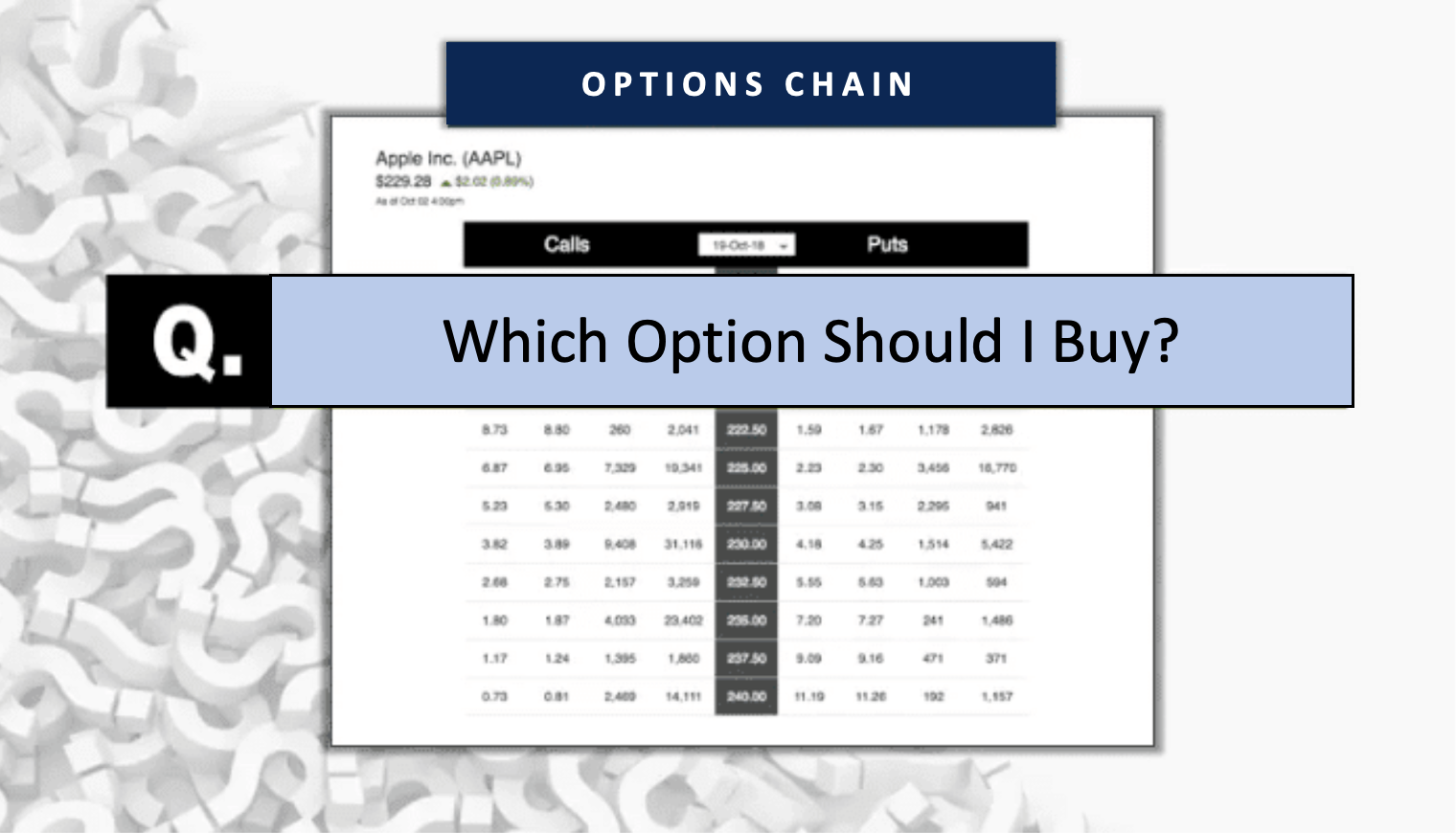
An options chain can contain dozens of strikes across multiple expiration dates, each with a different premium and payoff. To choose among them, investors are introduced to a series of concepts that are supposed to help narrow the field.
The problem is that one answer often creates another question.
Here are the seven questions that still leave investors without a clear answer.
1. Which Option Should I Buy and Why?
Suppose a stock is trading at $100 and you believe it has substantial upside over the next several months.
You can buy a lower strike that costs more, a higher strike that costs less, or something in between. You can buy an option expiring in a few weeks, several months, or much later.
You need some way to decide which combination of strike and expiration makes the most sense.
A common place to start is Delta.
2. What Delta Should I Choose?
Should you buy a 70 Delta option, a 50 Delta option, or a 30 Delta option?
There is no universally correct Delta. A higher Delta generally gives you more sensitivity to movements in the stock, while a lower Delta generally costs less. Neither characteristic tells you which option is best for the stock move you expect.
Delta also changes as the stock moves and as other option-pricing inputs change. So choosing a Delta cannot really be separated from the strike and expiration you choose.
Now you have another decision to make.
3. How Much Time Should I Buy?
If you expect the stock move to happen within two months, should you buy two months of time, three months, or six?
Buying more time gives the thesis longer to work, but that additional time costs money. Buying less time may improve the potential return if the move happens quickly, but it also leaves less room for the thesis to develop.
The expiration you choose also affects Delta, Gamma, Theta, and the value of the option. That means your answer to the time question can change the Delta you were just considering.
Once you begin comparing the cost of those different expirations, another issue appears.
4. Is Implied Volatility Too High?
You find an option that seems to fit your idea, but its implied volatility looks high.
Should that stop you from buying it?
Higher implied volatility generally means a higher option premium, all else equal. But knowing that IV is high still does not tell you whether the option is attractive for the stock move you expect.
If you expect a very large move in the stock, paying a higher premium may still make sense. If you expect only a small move, even an option with relatively low implied volatility may offer little opportunity.
So, the phrase “high IV” raises the next question:
High relative to what?
5. Should I Compare Implied Volatility With Historical Volatility
One common answer is to compare implied volatility with the volatility the stock has experienced in the past. While there are obvious problems with comparing a forward-looking stock view with “backward” historical measures of volatility, let's assume for the moment that the comparison is useful.
Even then, more questions appear. Which historical period should you use? Twenty days? Thirty days? One year? Should recent volatility matter more than older observations?
And after making that comparison, how does it tell you which strike and expiration to buy, especially when different strikes can trade at different implied volatilities?
Now the investor is not just choosing which volatility measure to compare. They also have to decide which strike’s implied volatility matters most for the decision.
And there is still another variable to consider: Theta.
6. How Much Theta Is Too Much?
Theta tells you how the theoretical value of an option is affected by the passage of time, assuming the other pricing inputs remain unchanged.
But how much Theta is acceptable?
Buying more time may reduce the pressure from time decay, but it also means paying more premium. Buying less time may cost less, but the option can lose value faster as expiration approaches.
Trying to reduce Theta therefore sends you back to the expiration decision, which can also change Delta and Gamma.
The questions are beginning to circle back on one another.
7. How Much Gamma Do I Need?
Gamma measures how quickly Delta changes as the stock moves.
For a directional investor, more Gamma can sound attractive because the option's Delta can increase faster if the stock starts moving in the expected direction.
But getting more Gamma may require changing the strike or expiration. That changes Delta, Theta, and the premium you pay.
The Gamma question has now taken you back to decisions you were already trying to solve.
The Seven Questions Form a Web
This is the real problem.
These are not seven questions arranged in a straight line.
This is one question with a web of questions formed around it, obscuring the fact that there is no clear process for reaching an answer.
So, instead of moving neatly from Question 1 to Question 7, the investor begins moving around a maze of interrelated variables.
Every answer changes another answer.
It becomes a multi-dimensional puzzle that is nearly impossible to keep straight.
And after attempting to work through it all, the original question, option’s hardest question, is still waiting:
Which option should I buy and why?
Before showing you the answer used by top hedge fund managers, let me show you exactly what almost everyone misses.
Once you see it, everything becomes clear.
Explore the OptionsGeek Framework

Information contained in any email and this website maintained by OptionsGeek, LLC (“OptionsGeek”) are provided for educational purposes only and are neither an offer nor a recommendation to buy or sell any security, options on equities or indices, or cryptocurrency. OptionsGeek and its affiliates may hold a position in any of the companies mentioned. OptionsGeek is neither a registered investment adviser nor a broker-dealer and does not provide customized or personalized recommendations. Any one-on-one coaching or similar products or services offered by or through OptionsGeek does not provide or constitute personal advice, does not take into consideration and is not based on the unique or specific needs, objectives or financial circumstances of any person, and is intended for educational purposes only. Past performance is not necessarily indicative of future results. No trading strategy is risk free. Trading and investing involve substantial risk, and you may lose the entire amount of your principal investment or more. You should trade or invest only “risk capital” - money you can afford to lose. Trading and investing are not appropriate for everyone. We urge you to conduct your own research and due diligence and obtain professional advice from your personal financial adviser or investment broker before making any investment decision.
OptionsGeek, LLC @2026 All Rights Reserved